As an Iranian Jew, I can barely sit through five minutes of Max Blumenthal’s latest project without feeling anger and disgust. Blumenthal, a fringe propagandist masquerading as a journalist, has released a new film via his dubious media company The Grayzone about the remaining Jewish community inside the Islamic Republic of Iran. He calls it Uncaptured: Jews in the Islamic Republic of Iran. In truth, it is a regime-approved showcase designed to launder the image of one of the most repressive governments on earth while exploiting a silenced, vulnerable minority.
Let’s first acknowledge some basic indisputable facts: No foreign journalist is allowed to film inside Iran without official permission, almost certainly from the Ministry of Culture and Islamic Guidance (or one of its propaganda arms). Jews in Iran cannot freely speak on camera. Every word, every frame of footage, is pre-screened, pre-arranged, and tightly managed. Presenting such staged performances as “authentic” voices is not journalism, it’s complicity in censorship.
And for what? For Blumenthal’s own clout? For his reputation as the contrarian willing to go where others won’t? Parroting a theocratic dictator’s talking points is not bravery, and turning a persecuted community into props is not noble.
I take this personally. My mother’s entire family, like tens of thousands of other Jews, was forced to flee Iran after the 1979 revolution. They left behind homes, businesses, graves, and a 2600 year history because life under the regime was unbearable. Those who stayed behind survive only by appeasing the authorities, living under constant suspicion, and carefully avoiding even the hint of sympathy for Israel or Zionism. Their continued presence is not evidence of protection, but rather, evidence of submission. They live as hostages, not as free citizens.
If Max Blumenthal had any shred of journalistic integrity, or even just an ounce of basic human decency, he would acknowledge that Jews in Iran live at the mercy of the regime, surviving through compliance. But integrity and decency are not his business. Did he bother to speak to Jews who actually lived under the regime and had to leave? Did he ask my friend, Jewish-Iranian activist Elham Yaghoubian, who was forced to flee in 1999 for daring to speak out? Did he talk to Hassan Sarbakhshian, the non-Jewish Iranian photojournalist who published Jews of Iran: A Photographic Chronicle and was later forced into exile after the Ministry of Culture branded his work “propaganda for Judaism”? Did he listen to the countless Iranian Jews in the US, Europe, and Israel who can testify to why they left? Of course not, because their testimony would collapse the very premise of his “film”.
Instead, Blumenthal places himself in the same camp as the regime’s apologists and useful idiots online. In the film itself, he even repeats the disinformation that Iran is home to the “second largest Jewish community in the region.” While that is true, what makes it disinformation is what he and his ilk never admit: that today’s community is barely ten percent of what it once was. Before the 1979 revolution, there were 80,000 to 100,000 Jews in Iran. Today just 8,000 to 10,000 remain, and the only reason this remnant is the “second largest in the region” is because 850,000 Jews were expelled or forced to flee from surrounding Arab countries in the mid-20th century. The survival of this community is not proof of tolerance, it’s proof of how thoroughly Jews have been ethnically cleansed from much of the Middle East.
Blumenthal goes even further. He boasts that what he found in Iran was an “authentic brand of Judaism … uncaptured by the militaristic force of Zionism.” This parrots the regime’s script: that Jews are acceptable only if they distance themselves from Israel, that their authenticity depends on submission. By echoing it, Blumenthal is not documenting Jewish life, he’s weaponizing a silenced minority against their own people.
The film is co-directed with Maria Mavati, a Kurdish-Iranian documentary filmmaker whose work circulates within Tehran’s state-sanctioned film industry. Working with an Iranian filmmaker who operates inside that system makes it obvious this wasn’t a free or unmonitored project. Like everything else in the film, it was vetted, permitted, and shaped by the regime’s boundaries.
The reality Blumenthal won’t show you is one of constant suspicion. The regime uses arrests and intimidation to remind Jews of their precarious status. One false accusation of contact with Israel, one rumor of helping someone escape, one stray word, and prison awaits.
This is not hypothetical. In November 2024, the regime executed Arvin Ghahremani, a 20-year-old Jewish citizen, after a trial that highlighted its system of religious apartheid and legal inequity. His case made plain what Iranian Jews (and other religious minorities) have always known: they face institutionalized harsher treatment, fewer protections, and discriminatory outcomes in the courts. In mid-2025, the regime arrested more than 700 people in just 12 days for alleged ties to Israel, including rabbis and community leaders whose phones and computers were confiscated. Since then, the definition of “espionage” has been expanded so that virtually any contact with Israel or Israelis can be punished with prison, or even death. For Jews, many of whom have family and cultural ties to Israel this is a hostage situation written into the penal code.
And go back further: in 1999, 13 Jews from Shiraz and Isfahan - among them a rabbi, teachers, and merchants — were arrested on fabricated espionage charges and sentenced to prison. International outcry didn’t erase the lesson: at any moment, Jews could be scapegoated as spies to keep the rest of the community in line.
Over the years I’ve reported on my social media about Jewish individuals in Iran who were mistreated or arrested, only to be contacted by their frantic family members or friends begging me to take down the posts. Publicizing their suffering, they explained, would only make things worse. They would be accused of conspiring against the regime and the whole family or even community could pay. This is what it means to live under a gag order enforced by fear. Blumenthal knows this, yet he dares to pass off regime-approved statements as the unfiltered voice of Iranian Jewry.
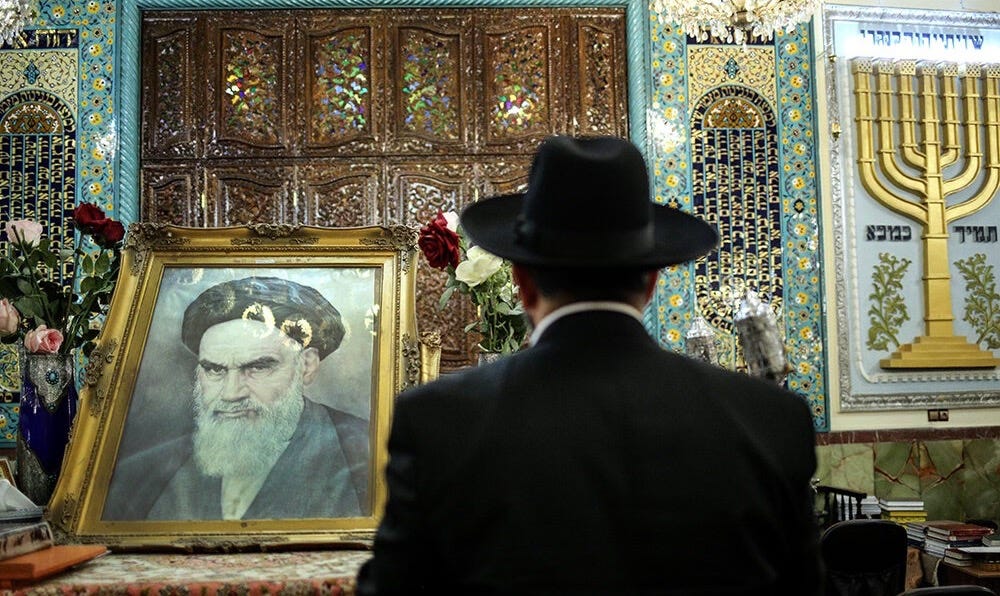
The control is visible in every synagogue and Jewish school. Portraits of Ayatollah Khomeini hang on the walls, a constant reminder of the Islamic Republic’s grip. After the 1979 revolution, his name and slogans were painted on synagogue walls across Iran. Reports from the time describe how Jewish institutions, from synagogues to schools to kosher butcher shops, were compelled to display loyalty to the new rulers. Forcing a non-Muslim minority to glorify the man who brought them such suffering is an act of subjugation and humiliation.
Even Jewish holidays are not off limits. In 2023, when Passover coincided with the regime’s annual anti-Israel al-Quds Day rally, Iran’s Jews were pressured to postpone their holiday observance and attend the march instead. A message circulated by the Jewish community’s official leadership — itself operating under heavy regime supervision - instructed: “Please do not go for picnics or enjoyable activities on al-Quds Day.” It went further, demanding Jews proclaim: “The Iranian Jewish community is separate from the Zionists. We are with Iranians and Muslims.” This was not a decision made freely by a religious community, it was coerced loyalty theater. Does Max Blumenthal truly believe observant Jews would voluntarily abandon Passover for a state parade? If he is a Jew - and he is - then he knows better. Yet once again, he chooses to sell his own people out.
Blumenthal exploits their silence. He exploits the fact that Jews inside Iran cannot contradict him. He exploits the systems that keep them muzzled, while he twists their image abroad to suit his narrative.
He does it all under the banner of “anti-imperialism” and “authentic Judaism.” Authentic to whom? To the ayatollahs who dictate every aspect of Jewish life in Iran? To Western activists eager for a Jewish fig leaf for their anti-Israel campaigns? Or only to Blumenthal himself, who has built a career siding with tyrants against the very people they oppress?
Max Blumenthal is not giving voice to Iran’s Jews, he is ventriloquizing the regime through them. He is turning a shrinking, silenced community into a weapon against the Jewish diaspora and against Israel. He is laundering oppression as authenticity.
This is exploitation, plain and simple.
As an Iranian Jew, I refuse to stay silent while my people are used as props. My family, and nearly every Iranian Jewish family I know, had to flee because life under the regime was intolerable. Those who remain do so by suppressing their identities and living as hostages. For Blumenthal to turn their captivity into a propaganda film has nothing to do with journalism. It’s obscene.
Max Blumenthal is not fit to speak on our behalf. He is not fit to pass judgment on our community. He is the lowest of the low: a man willing to stand on the backs of a persecuted minority to boost his own notoriety. He is not amplifying Jewish voices, he’s silencing them further, and handing the megaphone to their oppressors.
If history will remember him at all it will be as a propagandist who sold his own people out for clout - a man who collaborated with tyranny against the very people he pretended to document.
On behalf of Iranian Jews everywhere, including the ones in Iran who had to endure this pathetic charade, goh bokhor kesafateh regimi-eh bisharaf.
Comments
Post a Comment