In the early 21st century, the very idea of a Jewish nation-state is once again up for debate. New waves of post-colonialism, progressive radicalism, and historical ignorance are shaping a fresh narrative: "Maybe Israel shouldn't have been established." Such views, expressed in extreme political stances like that of New York City's mayor in 2025, who refuses to recognize Israel as a Jewish state, raise a profound question: What would happen if Zionism had failed? If Theodor Herzl hadn't written "The Jewish State" in 1896, if Jewish immigration to the Land of Israel never materialized, and if no sovereign state for the Jewish people emerged in 1948?
 |
| What Would a Lasting Peace Between Israel and Palestine Really |
1. The Absence of a Jewish National Home: A Historical Perspective
If the Zionist movement hadn't succeeded in its revival project, the Jewish people would have remained in exile, as they had for nearly two thousand years. The basic assumption of Zionism's opponents—that Jews would "merge" into surrounding cultures -ignores history. The 19th and 20th centuries tragically proved that modernization isn't a cure for antisemitism but often an accelerator of it.
In the 21st century, with the return of nationalism in Europe and new waves of migration, antisemitism is rising again under the guise of criticism of Israel. In international indices of Jew-hatred - in France, England, Germany - it's at peaks not seen in decades. In such a reality, a world without Israel means a world where Jews have no safe haven, no center of identity, and no address for diplomatic or military protection. In this sense, the State of Israel isn't just the state of its citizens - it's the existential insurance for the entire Jewish people.
2. Israel's Contributions to Science, Medicine, and Innovation
In the absence of the State of Israel, the world would lose a central engine of scientific and technological creation. Israel, a country of nine million people, is consistently ranked among the top five most innovative nations in the world (OECD, 2024). Its contribution to science far exceeds its size in a disproportionate way.
Medicine and Life Sciences
- Revolutionary drugs like Copaxone for multiple sclerosis treatment and Doxil for cancer were developed in Israel.
- Medical technologies such as laser eye surgeries, remote heart monitoring systems, and Optune for brain tumor treatment - all products of Israeli innovation.
- During the COVID-19 pandemic, Israel provided one of the world's most efficient models for national vaccination management.
Technology and Engineering
- The portable USB drive: an Israeli development that became a foundational element in digital culture.
- Waze, Mobileye, Check Point, Iron Dome, and Israeli contributions to Intel's processors:are just some of the achievements that have changed how the world exists, moves, protects itself, and connects.
- In agriculture, Netafim's drip irrigation method has saved entire regions of the world from thirst and famine.

In objective terms, the absence of Israel would leave humanity with less water, less food, less security, and less medical hope.
3. Social Structure and Values: Israel's Uniqueness in the Middle Eastern Space
Israel is a unique case of stable democracy in the heart of a region marked by totalitarianism, oppression, and violence. Neighboring countries—Syria, Lebanon, Iran, Iraq—show consistent patterns of state collapse, minority persecution, and women's exclusion.
In Israel, by contrast:
- Women have full political, legal, and military equality: including service in senior command roles.
- LGBTQ+ individuals enjoy legal rights and public recognition unmatched in the region.
- Religious minorities: Christians, Druze, Baha'is, Muslims, and Circassians: enjoy freedom of religion and worship.
- The Baha'i community sees Israel as the world center of their faith: a fact inconceivable in a world where in Iran, the birthplace of Baha'is, their faith is banned.
| Bahai Garden |
In a world without Israel, these communities would stand defenseless against hostile regimes. Israel's absence means the lack of an alternative. an island of freedom and pluralism in a sea of coercion.
4. Geopolitical Implications of Israel's Absence
The Middle East of the 20th century was built around a delicate balance between Arab states, Iran, and Israel. Removing Israel from the map would almost certainly lead to early Iranian expansion and reduced stability. Without the "democratic island" that serves as a reference point for the West, the region would devolve into a series of longer and more deadly regional wars.
Moreover, Israel serves as a top-tier source of intelligence and technological information for many countries, including the United States. Without its contribution, the balance of power in the Middle East would clearly tilt toward a radical and violent direction.
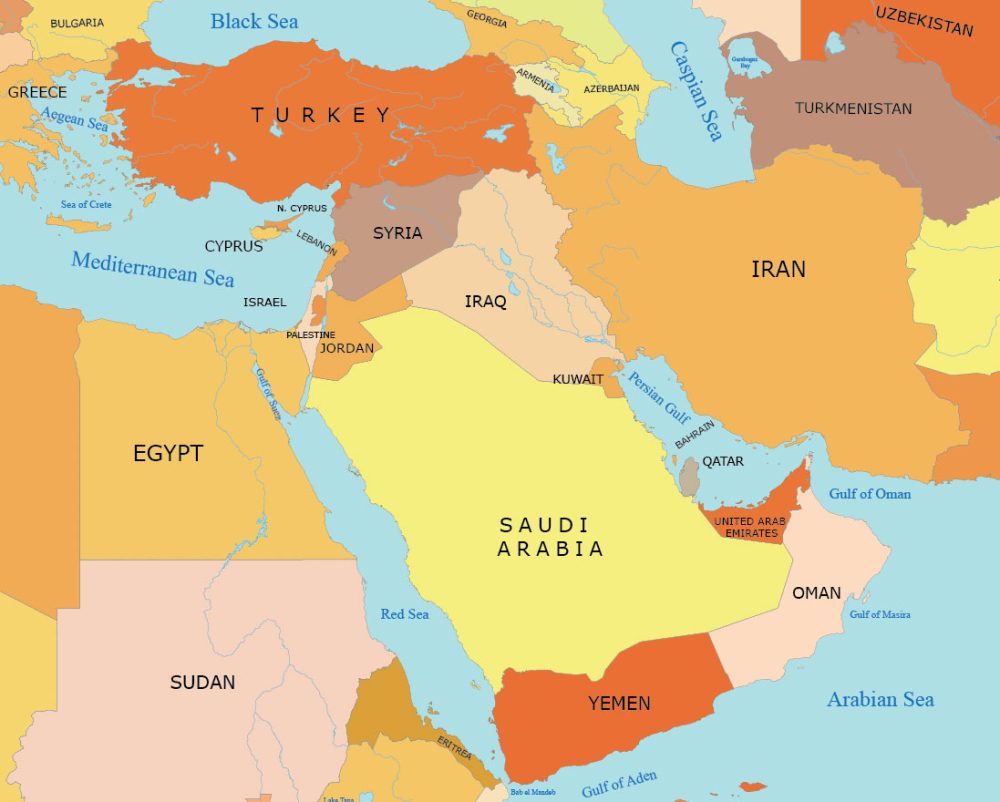 |
| Map Collection of the Middle East - GIS Geography |
5. Culture, Language, and Consciousness
Israel's cultural achievement isn't just in its inventions but in its very existence as a living culture. The revival of the Hebrew language, a biblical tongue turned into everyday speech. is a phenomenon without parallel in human history. Israeli literature, music, and cinema have contributed new voices to the world: Etgar Keret, Amos Oz, Meir Shalev, Netta Barzilai.
 |
| Revival of the Hebrew language - Wikipedia |
Without Israel, Jewish culture would retract back into religious or exilic boundaries. The Jewish people, instead of being a living nation in its homeland, would become a folkloristic community in the diaspora.
6. Moral Aspects
One must assume that a world where the Jewish state didn't arise might be more convenient for propaganda, but also morally blind. Israel's existence forces the world to grapple with questions of morality, power, self-defense, and democracy. Even when it fails, it's judged by moral standards no one demands from its neighbors. In its absence, there would be no one to serve as a constant reminder that democracy isn't a geographic privilege, but a daily choice.
Summary
A world without Israel wouldn't be a better world. It would be a world poorer in science, gloomier in morality, more dangerous in security, and shallower in culture. The absence of the Jewish state would leave a void not just geopolitical, but human.
Israel, with all its complexities, is one of the most impressive experiments of humanity in the modern era: an ancient people returns to its land, creates a free state, and seeks to integrate tradition with innovation, security with morality, particularity with universality.
Therefore, the real question isn't how the world would look without Israel, but how it would survive without it.
Keywords: world without Israel, Israeli innovations, Zionism hypothetical, Middle East without Israel, Jewish state contributions, Israeli technology impact, religious freedom in Israel, geopolitical Middle East, Hebrew revival, antisemitism history
Comments
Post a Comment