We are all in Palestine now,
and there is no escaping it
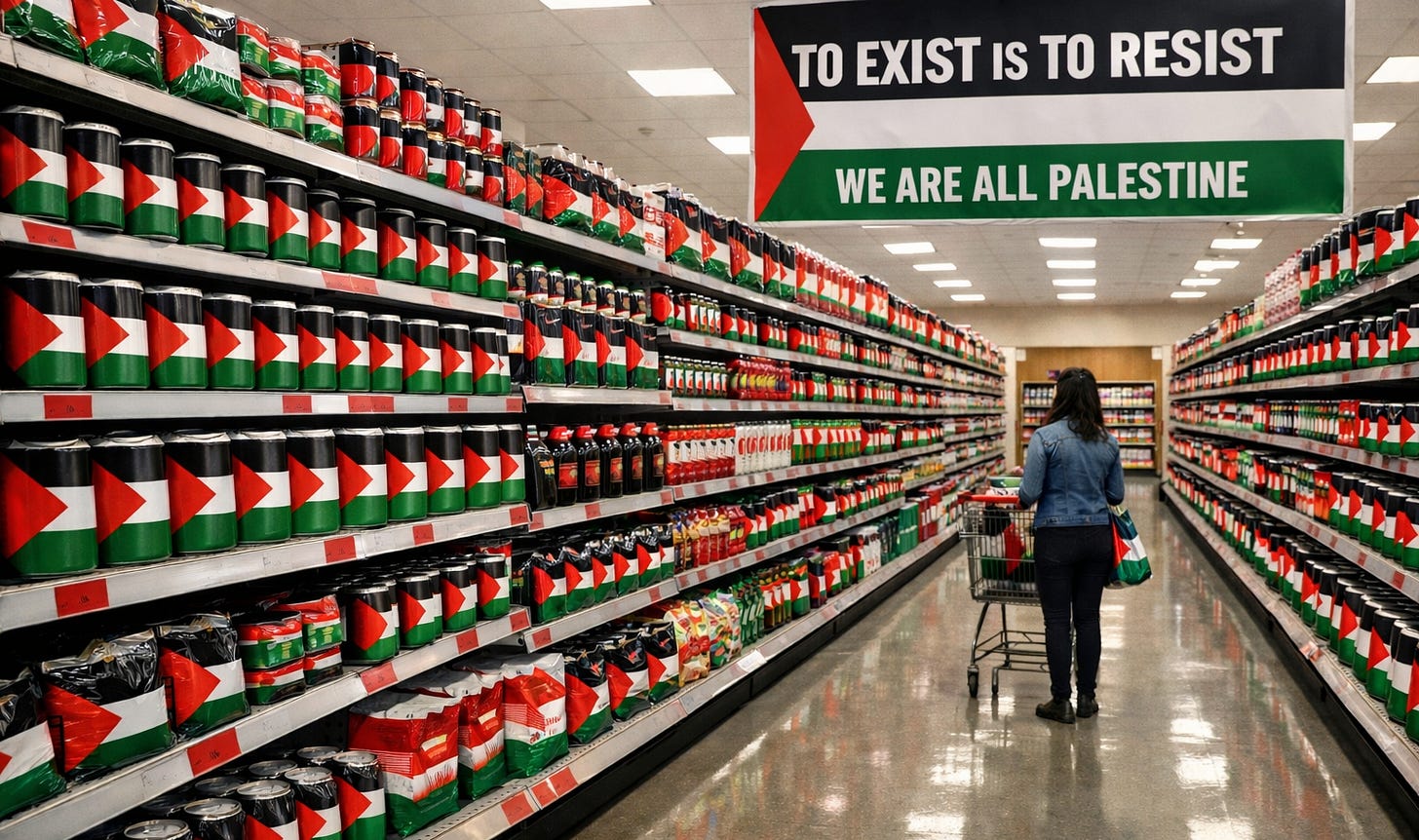
For decades, we have been told a simple story: Palestine was colonised.
That claim has been repeated so often that it has become a moral reflex, an unquestioned starting point for conversation.
According to the historical record, however, no such thing occurred, at least not in the way modern decolonisation activists imagine. There was no sovereign state of Palestine to colonise,1 no Palestinian government displaced by a foreign metropole, and no distant Jewish empire dispatching settlers from across the sea.
The dominant imperial powers in the region for centuries were not Jews but successive Muslim empires that expanded across the Middle East through, you guessed it, colonisation, often at the expense of indigenous minorities who were displaced, subordinated, or gradually erased.
That narrative also leaves out another inconvenient fact: many Jews never left the land at all, others arrived as survivors of genocide in Europe, and nearly a million more were expelled from the Middle East and North Africa in the twentieth century.2
They were not colonisers. They were refugees.
Whatever its faults, Israel is not a colonial empire. Any child with a map should be able to tell you that, provided they can even read the name on a country that small.
In other words, the fashionable decolonisation story we are told gets the basic shape of history backwards.
Now that we have cleared that up, we can move on to a different kind of colonisation.
Not of land.
Not of borders.
Not of territory in the Middle East.
I want to talk about the colonisation of everything else. Literally.
I’ll start with a small moment from last week that prompted this piece. My son is really into pirates and ships at the moment, so when I heard that a replica fifteenth-century ship was visiting nearby, I thought it would be the perfect outing. That is, until I noticed the Palestinian flag flying from it.
On a pirate ship.
Not this too. Is there anything, anywhere, at any time, that this cause does not manage to insert itself into?
Whatever you believe about this cause, its ability to appear in spaces that have nothing at all to do with it is genuinely impressive. Museums, cafés, charity bike rides, climate rallies, children’s play areas, farmers’ markets, yoga studios, book clubs, fun runs, music festivals, and the occasional bake sale that was supposed to be about cupcakes.
At this point, I would not be surprised to see this flag pinned to a lost dog notice.
Help me find my dog. It might free Palestine.
Everything is connected to Palestine, somehow. It has become the world’s most portable political accessory. From the scale of the spectacle, one might reasonably conclude that nothing else was happening anywhere on earth, which is of course patent rubbish. According to the United Nations, more than 300 million people worldwide are currently facing humanitarian crises.3 For context, roughly two million live in Gaza.
Yet humanitarianism, as currently practiced, appears to begin and end in Gaza, and even then only when Israel can be blamed.
And the strangest part is that “Palestine” does not only appear in places where it has no obvious business being. It has also become a recurring presence in spaces where it does not logically belong at all.
At pride rallies.
At anti-racism rallies.
In decolonisation courses at universities.
In institutions devoted to equality and historical truth.
These are environments where the same symbol has become a regular fixture, dutifully worn as a badge of virtue, even as the ideology and movements it represents openly embrace religious dominance, homophobia, racism, and the erasure of an indigenous minority.
The irony is hard to miss, but this movement seems to specialise in missing it. The moral confusion is harder still. What began as a distant geopolitical dispute has somehow become the cultural fashion statement of our time.
Somewhere, someone is making a tidy profit selling flags, tote bags, and matching accessories of the Palestine variety.
It also has a remarkable talent for breaking up relationships. Over the past two years, lifelong friendships have unravelled, families have split down the middle in the name of Palestine, and it is no longer unusual to hear of people cutting off close friends for failing to post the correct slogan about a conflict thousands of kilometres away.
I try to avoid the issue with people in our day-to-day lives, other parents, acquaintances, because there is only so much that can be explained between school pick-up and the car park. Unless the conflict is explained properly and in full, I know I will be subjected to a simplified, propagandised version that bears little resemblance to reality. One where Iran’s proxies, October 7, the hostages, and the repression of Palestinians by their own leaders simply don’t exist.
This is then followed by the subtle but unmistakable raising of a metaphorical wall the moment anyone senses that I might believe Jews, like every other people, have a right to self-determination. These days, that alone is enough to be considered unacceptable provocation.
Curiously, this level of moral fervour seems to apply to only one conflict on earth. There do not appear to be civilisational rifts between friends over Taiwan and China. I have yet to hear of anyone disowning relatives over the war in Sudan.
But in the case of Palestine, this isn’t solidarity. It is saturation, the steady occupation of every available space.
Diversity has given way to uniformity: the same flag, the same symbols, the same slogans repeated across institutions that once prided themselves on representing many voices.
It is no longer simply a geopolitical issue.
It has become a cultural identity.
And like many cultural identities, its primary function now appears to be signalling belonging rather than delivering results. Exactly how all this feverish flag-waving and sloganeering improves the daily life of an ordinary Palestinian family remains something of a mystery.
What now circulates through Western culture is not really about Palestinians as people. It is about Palestinianism, a portable collection of symbols, slogans, and moral signals that can be deployed almost anywhere, irrespective of their real-world impact on actual Palestinians.
In this system, Palestinians themselves become props, and their hardship the fuel. Those who claim to speak in their name often advance agendas that have little to do with their welfare, because their continued hardship keeps the cause alive.
But why? What is this phenomenon where I can’t maintain relationships within my own family, run a simple errand, or take my child to see a pirate ship without having my nose rubbed in this cause? If all this hoarding of airwaves and sucking of oxygen actually improved anyone’s life, it might make sense. But it doesn’t. Instead, it entrenches conflict, rewards extremism, and makes peace harder to achieve.
Causes do not spread this widely or embed themselves this deeply in everyday life by accident.
No, this is organised.
For decades, Islamist movements like the Muslim Brotherhood, whose ambitions extend well beyond the Middle East, colonial ambitions, dare I say, have understood something Western institutions have not yet grasped: you do not need to win a war to destabilise a society.
You only need to reshape its symbols and moral climate. Find a cause compelling enough, and a sizeable portion of the population will defend it as a test of their character.
Flood the media landscape with wrenching images, repeated often enough and framed simply enough, and viewers who cannot bear the suffering will be moulded into willing advocates.
And Western civilisation, if we are being honest, misplaced its centre some time ago, elevating compassion to the highest rung of our moral hierarchy and reorganising public life around it. We hold diversity workshops, rewrite mission statements, and compete for moral purity, all in the sincere belief that this is how a humane society is built.
It isn’t. It is how we become easy pickings for anyone running a disciplined external campaign.
Analysts such as Dalia Ziada have warned that the Palestinian cause has been deliberately cultivated as a strategic instrument,4 a narrative capable of mobilising emotion, shaping public opinion, and exerting pressure far beyond the battlefield. In her work on political Islam, she describes how movements like the Muslim Brotherhood recognised early that Western societies are uniquely vulnerable to moral language, particularly language framed around justice, oppression, and human rights.
“Palestine” was not a spontaneous movement. It was organised, funded, and carefully messaged.5 Activist networks, student groups, NGOs, and social media campaigns did not emerge organically. They were built, trained, and coordinated over years, often with professional infrastructure behind them, fundraising pipelines, media toolkits, and advocacy organisations capable of mobilising demonstrations within hours.6
Many of these groups run leadership training programs, provide messaging guidance, and share campaign materials across borders, ensuring that slogans, imagery, and tactics remain remarkably consistent from one city to the next.7
If you can persuade people that your cause is the ultimate moral test, they will carry your message for you. And before long, they will hound anyone who does not follow suit, demanding conformity and threatening cancellation.
The Palestinian cause became the lynchpin for that strategy. Emotionally portable. Morally charged. Endlessly adaptable.
It can and has been attached to almost anything, which is why the Palestinian flag, trailing its familiar entourage of watermelons, keffiyehs, slogans, and hashtags behind it, has become an inescapable fixture of everyday life, like an uninvited guest who never quite leaves.
The pressure does not come from open coercion but from living inside a permanent political climate that steadily colonises everyday spaces until ideas that once felt political simply feel normal.
That is how movements spread without armies, and ideas travel without borders. They simply move into everyday life as if they own the place, under cover of “humanitarianism.”
And once it settles in, it no longer asks permission to stay. It simply assumes you were expecting it.
If you value this kind of long-form work, paid subscriptions are what make it possible.
If subscribing isn’t for you, there’s also a one-off support option here: https://ko-fi.com/lucytabrizi. Thank you for reading and for supporting this work in whatever way fits you.
Efraim Karsh, Palestine Betrayed, Yale University Press, 2010; see also League of Nations Mandate for Palestine, 1922.
Lyn Julius, Uprooted: How 3,000 Years of Jewish Civilization in the Arab World Vanished Overnight, 2018; see also United Nations High Commissioner for Refugees historical estimates of approximately 850,000 Jewish refugees from Arab countries.
United Nations Office for the Coordination of Humanitarian Affairs (OCHA), Global Humanitarian Overview, 2024.
Dalia Ziada, The Curious Case of the Three Revolutions: Egypt 2011–2013, 2013; see also her policy commentary on political Islam and narrative mobilisation.
See RAND Corporation, The Role of Social Movements and Civil Society Networks in Political Mobilisation, 2021.
See United Nations Office of Internal Oversight Services, Investigation into UNRWA Staff Participation in the 7 October Attacks, 2024; U.S. Department of the Treasury, Treasury Sanctions Network Supporting Hamas, 2024; Associated Press, Italian police arrest nine over alleged Hamas funding through charities, 27 December 2025; The Guardian, Summer school activists plan pro-Palestinian protests at US colleges in fall, 16 August 2024.
See The Guardian, Pro-Palestine university protest camps spread across Australia, 23 May 2024.
Post by Lucy - Notes From The Ruins
Comments
Post a Comment